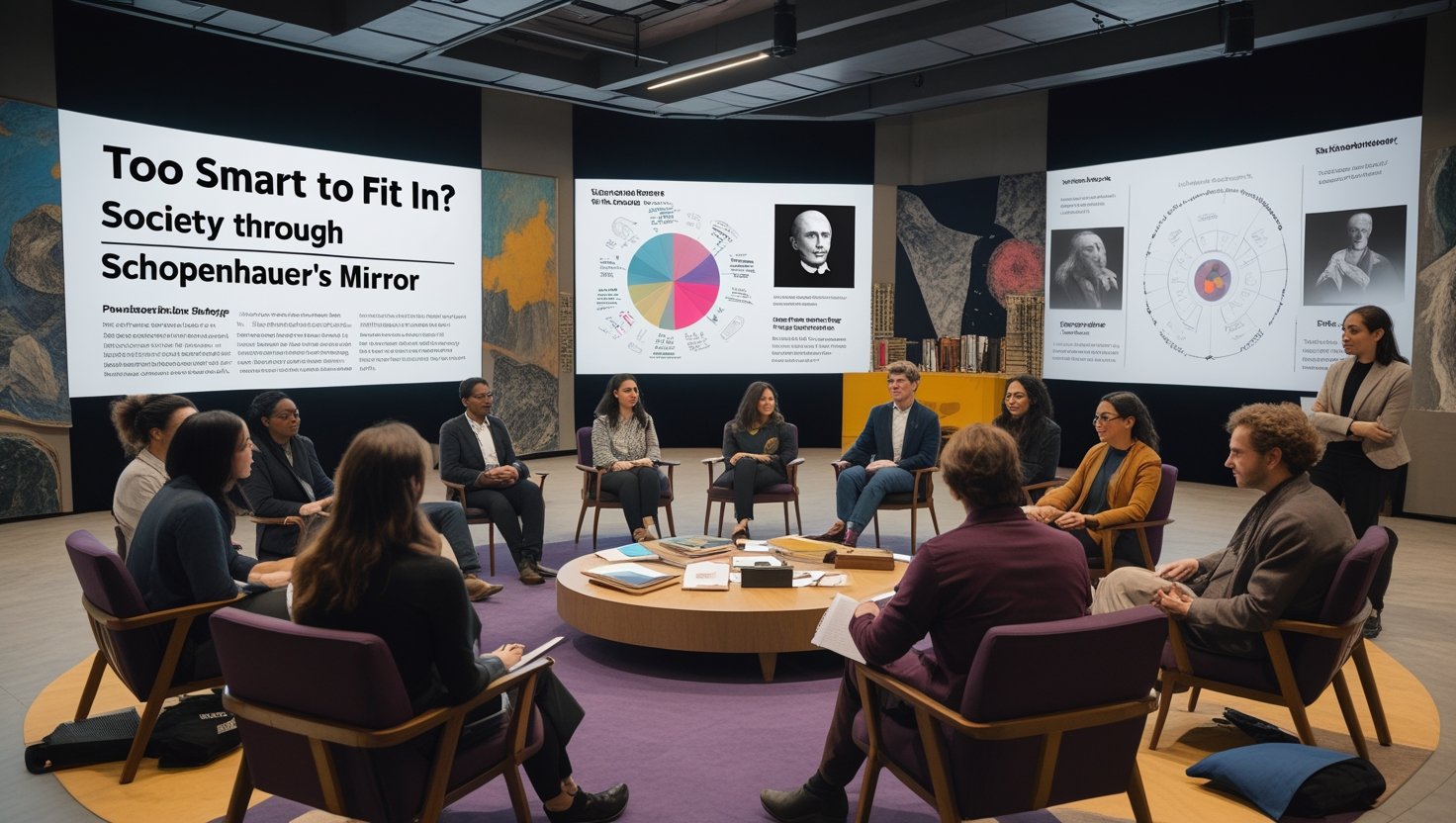
In a world that rewards likability over honesty and conformity over critical thinking, being truly intelligent can feel more like a burden than a blessing. Intelligent people often experience an uncomfortable sense of separation from society, not because they dislike others, but because their minds operate on a frequency that most people neither here nor understand.
This disconnect isn’t a modern psychological mystery; it was addressed centuries ago by Arthur Schopenhauer, one of the most unflinching philosophers in history. According to him, the problem is not with the intelligent individual, but with society itself.
Seeing Clearly in a World Built on Illusion:
Schopenhauer proposed that the world we live in is largely built on illusions. People need these illusions, whether it’s in the form of religion, nationalism, social roles, or even the myth of happiness, to function. Society thrives when people do not question too much, when they participate in shared beliefs without overanalyzing. The intelligent person, however, is cursed with the ability to see through these facades. They can’t just “go with the flow” because they’re painfully aware that the flow is often irrational or meaningless.
This clarity of vision is what Schopenhauer called a “mirror.” Intelligence, he believed, is like a sharp and clean mirror that reflects the unpleasant truths of the world, truths that most people are either unaware of or actively ignore. And in a society where survival often depends on shared delusions, those who reflect truth are seen as threats, not as guides.
The Unspoken Rule of Social Comfort:
Most social settings operate on a simple but powerful principle: make people feel good. Whether it’s a casual conversation, a workplace meeting, or a family gathering, the priority is to maintain comfort, not truth. The intelligent person, however, is often driven by inquiry, depth, and honesty. They ask inconvenient questions, challenge lazy thinking, and expose contradictions in commonly accepted norms. This makes others uncomfortable, even hostile.
Schopenhauer observed that people don’t want to be enlightened; they want to be entertained or affirmed. Therefore, someone who seeks truth and philosophical reflection often finds themselves on the margins of social life. They are too deep for shallow settings, too skeptical for religious communities, too honest for political correctness, and too quiet for noisy environments. As a result, they begin to detach not out of superiority, but out of incompatibility.
Intelligence and the Weight of Meaning:
One of the least discussed but most devastating realities of high intelligence is the constant search for meaning. While others can be satisfied with routine, distraction, or simple pleasures, the intelligent person constantly asks: What’s the point? Why am I doing this? What is the deeper value? This obsession with purpose makes it hard to find lasting contentment in a society designed for consumption, repetition, and distraction.
Schopenhauer didn’t sugarcoat this dilemma. He claimed that life itself is inherently filled with suffering, and that most people cope by distracting themselves through desires for money, sex, fame, and power. Intelligent people, however, often see through these pursuits and recognize their emptiness. But this recognition doesn’t lead to peace; it leads to existential discomfort. And when they try to express this discomfort, they find that most people are either unwilling or unable to engage.
Alienation as a Side Effect of Awareness:
The more aware you are, the lonelier you become. This is not pessimism; it’s a pattern that repeats across history, psychology, and literature. People who think deeply, question relentlessly, and observe keenly tend to live on the edge of social structures. They don’t trust easily, they don’t follow blindly, and they don’t engage in superficiality with ease. This makes them difficult companions in a world where shallowness is the norm.
Schopenhauer believed that the intelligent person often becomes a voluntary outsider. They are not exiled by force, but by choice, a painful, necessary choice. They prefer solitude over compromise, depth over attention, and meaning over entertainment. This self-imposed exile is not always dramatic or visible. Sometimes it’s just the quiet refusal to participate in conversations that don’t matter, or the quiet withdrawal from a social scene that feels fake. Over time, the intelligent person drifts further and further away from what is considered “normal.”
The Tragedy of Being Misunderstood:
One of the greatest burdens of intelligence, according to Schopenhauer, is being misunderstood not because the intelligent person fails to express themselves, but because others lack the framework to receive it. When an intelligent person speaks about the illusions of society, or the hollowness of modern life, or the cyclical nature of human suffering, they are often labeled as negative, cynical, or arrogant.
This mislabeling creates emotional fatigue. Over time, the intelligent individual stops explaining themselves. They retreat into books, into thought, into silence, not because they are antisocial, but because the cost of communication becomes too high. Even when they do find people to talk to, they often feel the need to “dumb down” their ideas or filter their thoughts just to avoid awkwardness. This constant masking of one’s authentic thoughts erodes the spirit.
The False Ideal of Fitting In:
Society promotes the idea that fitting in is the ultimate social success. From childhood to adulthood, people are taught to adapt, to blend, to adjust. But Schopenhauer would argue that for the intelligent person, fitting in is often a form of self-betrayal. To truly fit in, they would have to unseen what they’ve seen, unsay what they believe, and unlearn what they know. In essence, they would have to become someone else.
This is not just difficult, it’s impossible. The intelligent mind cannot unknown the truth. It cannot participate fully in illusions once it has seen their cracks. Therefore, the intelligent person must make a choice: fit in and suffer internally, or stand apart and suffer externally. Neither option is easy, but at least the latter preserves one’s integrity.
Why Schopenhauer’s View Still Matters Today:
We live in an age where intelligence is more accessible than ever. Information is everywhere, ideas circulate at the speed of light, and education has expanded beyond borders. And yet, true intelligence, the kind that sees beyond headlines, beyond social media, beyond trends, is still rare. And still lonely.
Schopenhauer’s philosophy reminds us that intelligence is not about status, it’s about sight. It’s about seeing the world, painfully, and truthfully. In a society that often rewards illusion, distraction, and obedience, this kind of sight is radical and deeply isolating.
But it is also necessary. Every society needs its truth-tellers, its questioners, its seers. Even if they don’t fit in, even if they live on the fringes, they serve a crucial role: reminding the rest of us that life is more than entertainment, more than conformity, and more than noise. They are the mirrors in which society sees its real face if only it dares to look.
Conclusion:
So, if you’ve ever felt like you don’t belong, not because you dislike people, but because you see through them, remember that you’re not broken. You are simply aware. And in Schopenhauer’s world, awareness is both a burden and a gift. It isolates you from society, yes, but it also frees you from its illusions.
You may not fit into the world. But perhaps, you were never meant to. Perhaps your role is not to blend in, but to reflect. Not to follow, but to question. Not to entertain, but to awaken. And that, in the deepest sense, is not a weakness but a form of courage.
FAQs:
1. Why do intelligent people often feel like they don’t belong in society?
Because their intelligence allows them to see through illusions that society is built upon, like social roles, traditions, and collective beliefs. Schopenhauer believed that intelligent individuals perceive reality more clearly, and that clarity creates a mismatch with a world driven by comfort, conformity, and distraction. This leads not to arrogance, but to emotional and intellectual incompatibility.
2. What does Schopenhauer mean when he says intelligence is like a mirror?
He means that intelligence reflects truth clearly, even when that truth is unpleasant. Most people avoid difficult realities by clinging to comforting illusions, but the intelligent person, like a mirror cannot help but reflect what is real. This reflection makes others uncomfortable and often leads to social alienation.
3. Why is social life often difficult for highly intelligent individuals?
Social interactions prioritize comfort over truth. Conversations are often superficial, and challenging commonly held beliefs can be seen as rude or negative. Intelligent people, who seek depth and honesty, naturally disrupt these dynamics, leading others to label them as cynical, arrogant, or too intense, causing isolation or withdrawal.
4. Is solitude a choice or a curse for intelligent people?
According to Schopenhauer, solitude is often a necessary and even noble choice. Intelligent people may not be forced out of society, but they step back because fitting in would require them to suppress their true selves. Solitude becomes a way to preserve integrity in a world that rewards masking, not authenticity.
5. What is the core message Schopenhauer offers to intelligent individuals who feel alienated?
He reminds them that not fitting in is not a failure—it’s a reflection of their awareness. True intelligence, while isolating, serves a deeper purpose: to reflect, to question, and to awaken. Intelligent individuals may be outsiders, but they play a vital role in revealing the hidden truths of society.